Coilovers Buyer’s Guide: How to Choose the Right Setup for Your Build
Table of Contents
Thinking about upgrading your suspension? A coilover conversion is one of the smartest performance upgrades you can make. Whether you're chasing the perfect stance, smoother street manners, or track-ready handling, QA1 coilovers give you complete control to dial in your ride — no compromise necessary.
In this buyer’s guide, we’re breaking down what coilovers do, why they matter, and how to choose the right system for your ride.
What Are Coilovers?
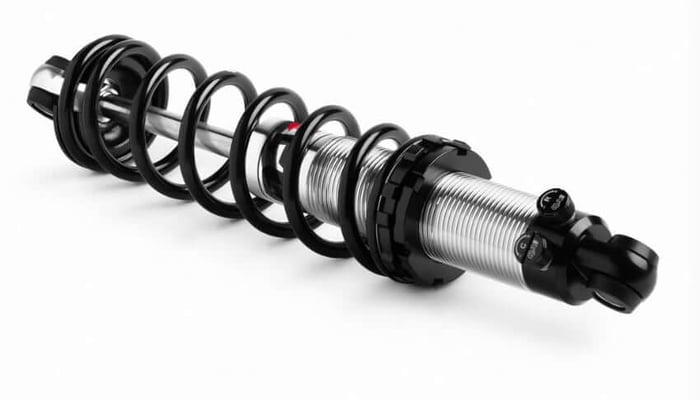
A coilover, AKA a coilover shock, combines a coil spring and a shock absorber into a single, compact unit — designed to be adjustable. Unlike fixed or traditional setups, coilover kits let you easily fine-tune ride height, suspension stiffness, and even shock valving depending on the model you choose.
From muscle cars and restomods to street trucks and full-on race builds, coilovers give you a versatile, modern suspension solution.
Learn more about the differences between lowering springs and coilovers.
Why Go with QA1 Coilovers?
At QA1, we don’t just build suspension parts — we engineer complete ride solutions. QA1 coilover are built in-house in Lakeville, Minnesota, tested on real vehicles, and backed by people who know how your car should feel on the street or at speed.
Here’s what makes QA1 coilovers stand out:
- Ride Height Adjustability
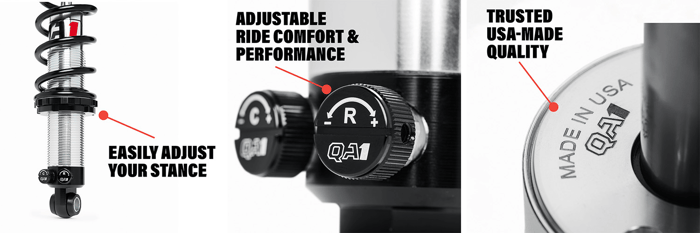
Set the perfect stance, eliminate wheel gap, or dial in weight distribution. Learn how ride height works
Improved Handling
Reduce body roll, improve cornering, and stay planted — whether you're on backroads or the autocross course.Tunable Performance
Choose between single, double, or 4-way-adjustable valving to match your driving style.Rebuildable + Revealable
Designed to evolve with your build — not wear out with time.Made in the USA
Built with pride and backed by an industry-leading warranty.

How to Choose the Right Coilovers
1. Define Your Driving Goals
Your ideal coilover setup depends on how and where you drive.
- Street Performance: Looking for a smoother ride with adjustable stance? Single adjustable coilovers are a great choice.
Performance Driving: Go with double adjustables to fine-tune rebound and compression for maximum grip. Performes great on the street, and the track
Autocross or Drag Racing: Look for coilovers with advanced tuning and . For the best performance, check out QA1's 4-Way Adjustable MOD Shocks.
🔧 Pro Tip: Not sure what’s best for your build? Our tech team is here to help. Visit QA1.net/contact/ to get in touch.
2. Check Fitment
We make coilovers for:
Classic muscle cars (Camaro, Mustang, Chevelle, etc.)
Modern muscle and sports cars
Classic and late-model trucks (C10, OBS, S10, F100, etc.)
Custom and race applications
Shop by vehicle platform at QA1.net/vehicles/ to find solutions that fit your ride.
3. Choose the Right Adjustability
Single Adjustable: Easy to adjust. Best for street and occasional track use.
Double Adjustable: Adjust rebound and compression independently. Ideal for advanced tuning and serious performance.
4-Way Adjustable: Specifically designed to meet the demands of high performance drag race, pro-touring, and track cars, which require higher force curves as their performance levels increase.
4. Spring Rates Matter
Spring rate has a huge impact on how your suspension feels. Too soft? You’ll float. Too stiff? Your ride becomes harsh.
QA1 offers multiple spring rates, and we’ll help you match them based on:
Your car’s weight
Driving style
Desired ride comfort or performance
Pro Tip: Use our Spring Rate Calculator Guide to get started.
QA1 Coilover Kits: Easy to Install, Built to Perform
QA1 front and rear coilover kits are designed for bolt-on installation, with many kits requiring no cutting or welding. Install them in your garage with standard tools and enjoy:
Pre-assembled shocks & hardware
Clear installation instructions
Lifetime support from QA1 experts
Compare QA1 Suspension Options
From engineering and testing to ride quality and service, QA1 suspension solutions are built to handle your lifestyle, your build goals, and your performance standards.
| FEATURES | COILOVER SHOCKS | TUBULAR SUSPENSION | FULL VEHICLE KITS |
|---|---|---|---|
| Ability to easily adjust for the perfect stance | ✓ | ✓ | |
| Easily installs without the need for special tools | ✓ | ✓ | ✓ |
| Optimized ride quality and handling | ✓ | ✓ | ✓ |
| Industry leading warranty | ✓ | ✓ | ✓ |
| Made in the USA | ✓ | ✓ | ✓ |
| Lightweight, bind-free tubular components | ✓ | ✓ | |
| Powder coated for long-lasting durability | ✓ | ✓ | |
| All-in-one solution for your entire vehicle | ✓ |
Ready to Upgrade Your Suspension?
Ready to upgrade your ride? Browse all front, rear, and full vehicle QA1 coilover systems or give us a call at 952-985-5675. We’ll help you find a system that delivers performance, comfort, and confidence — all in one package.
FAQs
What's do I need to know before purchasing coilover springs?
When looking for a set of coil-over springs for your vehicle, it’s a good idea to have the actual weight of your vehicle, rather than a guess or description. Knowing the true weight of your vehicle will make it easier to pinpoint the spring rate that makes the most sense to maximize your vehicle’s ride and performance.
While scaling the vehicle, make sure to get not only the overall weight, but also scale the vehicle to find the weight distribution. Meaning, weigh the front of the car separately, and weigh the back of the car separately. Generally, the front spring rate doesn’t depend on the rear weight of the vehicle, and vice versa. Several factors should be considered when purchasing a set of coil-over springs, such as the intended use of the vehicle, but just knowing the weight of the car is a great place to start.
If you don’t have a set of scales at home, local shipping centers, recycling centers or truck weigh stations many times are the next best place to scale the car.
How do I measure my car's ride height?
Here’s what we recommend: compressed and extended mounting lengths are measured from the center of the loops to the shock/stud shoulders. If the measurements are taken from mounting surface to mounting surface, subtract 5/8” for each shaft/stud end. The preferred measurement in most cases is taken with the car sitting on the ground ready to go.
If setting up the chassis for the first time, simulate the approximate ride height before measuring. In most cases, we recommend the shock to be half-way compressed at ride height to ensure adequate compression and rebound travel.
Is there a difference between shock ride height and chassis ride height?
Shock ride height is a specified range that is measured from mounting point to mounting point that the shock is designed to work within under normal operating conditions. This measurement is taken or set with the chassis ride set where it needs to be for the specific application. It is designed to allow the shock enough travel in both directions so that the shock will not top or bottom out.
How much shock travel do I need?
Most street driven vehicles should have a minimum of 2.5" to 3" of compression travel at the wheel and 2" to 2.5" of rebound travel as a good rule of thumb. Now that the wheel travel has been established we can look at shock travel for different suspension types. A solid axle suspension generally has the shocks mounted to the axle where shock and wheel travel will be the same (1:1 motion ratio). An independent suspension has a motion ratio that will generally be in the 0.5 to 0.66 range and does not require as much travel in the shock because the shock is only moving 0.5" to 0.66" for every one inch the wheel travels. This is why the rear suspension on most cars with a solid axle should be using a shock with at least five inches of travel while the independent front suspension can use as little as three inches of shock travel.